
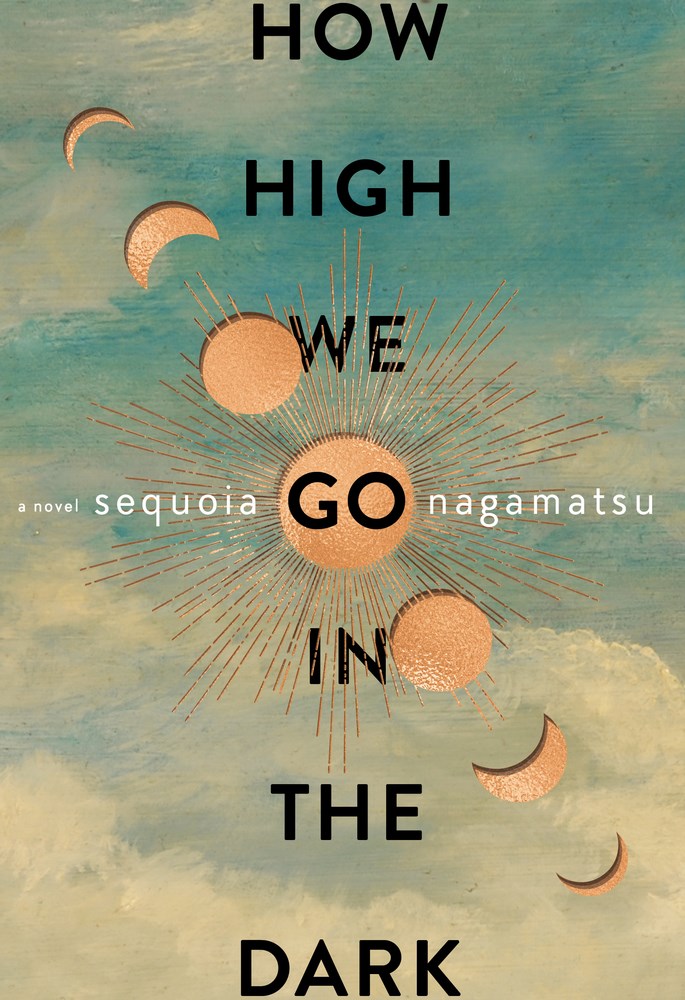
Blurb from Goodreads:
For fans of Cloud Atlas and Station Eleven, a spellbinding and profoundly prescient debut that follows a cast of intricately linked characters over hundreds of years as humanity struggles to rebuild itself in the aftermath of a climate plague—a daring and deeply heartfelt work of mind-bending imagination from a singular new voice.
Beginning in 2030, a grieving archeologist arrives in the Arctic Circle to continue the work of his recently deceased daughter at the Batagaika crater, where researchers are studying long-buried secrets now revealed in melting permafrost, including the perfectly preserved remains of a girl who appears to have died of an ancient virus.
Once unleashed, the Arctic Plague will reshape life on earth for generations to come, quickly traversing the globe, forcing humanity to devise a myriad of moving and inventive ways to embrace possibility in the face of tragedy. In a theme park designed for terminally ill children, a cynical employee falls in love with a mother desperate to hold on to her infected son. A heartbroken scientist searching for a cure finds a second chance at fatherhood when one of his test subjects—a pig—develops the capacity for human speech. A widowed painter and her teenaged granddaughter embark on a cosmic quest to locate a new home planet.
From funerary skyscrapers to hotels for the dead to interstellar starships, Sequoia Nagamatsu takes readers on a wildly original and compassionate journey, spanning continents, centuries, and even celestial bodies to tell a story about the resiliency of the human spirit, our infinite capacity to dream, and the connective threads that tie us all together in the universe.
This is a remarkably difficult book to review, partly because it’s really hard to categorise. It’s literary dystopian science fiction? Maybe? With a heavy emphasis on humanity and death. Now, full disclosure, even though I’m a pathologist, reading about death is not a fun time for me and there is a lot of death in this book. Starting in the future (2030), when the melting polar ice caps have led to the discovery of the body of an ancient girl and the re-emergence of a deadly virus, it probably doesn’t sound like the most appealing subject matter in these difficult times. However, the virus is a nothing that resembles a known disease, which made it easier to read.
This is not a long book but a huge amount happens, without being overly dense. It consists of many different stories, with some connecting threads and characters, but with very separate narratives. The toughest one for me is the section about a theme park for terminally ill children that is, essentially, a euthanasia park. These unknowing children get to have one good final day. What’s fascinating about this book is the exploration of how humanity and earth will deal with death on a massive, continuous scale. The funerary hotels and the whole culture around death is really fascinating.
The writing is tight, the dialogue excellent and the characters entirely believable, even in those settings that are entirely unlike our current existence. Some characters aren’t particularly likeable (but doesn’t that make them even more believable?) and some of the sections are a little more impenetrable than others. I’m not sure what I make of the very final section that ties it all together. I’m not sure it was necessary, to be honest, and it was a slightly weak ending, for me, but all of the stories and all of the people more than made up for that.
This book isn’t a laugh a minute, and sometimes it’s extremely bizarre, but it’s well worth checking out with, of course, the warning that there’s so much death. So much. It looks inward, into a network of coma dreams, and it looks outward (upward) to the stars, and it is certainly deeply thought-provoking.
Rating: 4 stars (grim but entertaining)
TL;DR: A book about melting ice caps and a virus and so much death but also fascinating, compelling and very readable.

 whelmed.blog